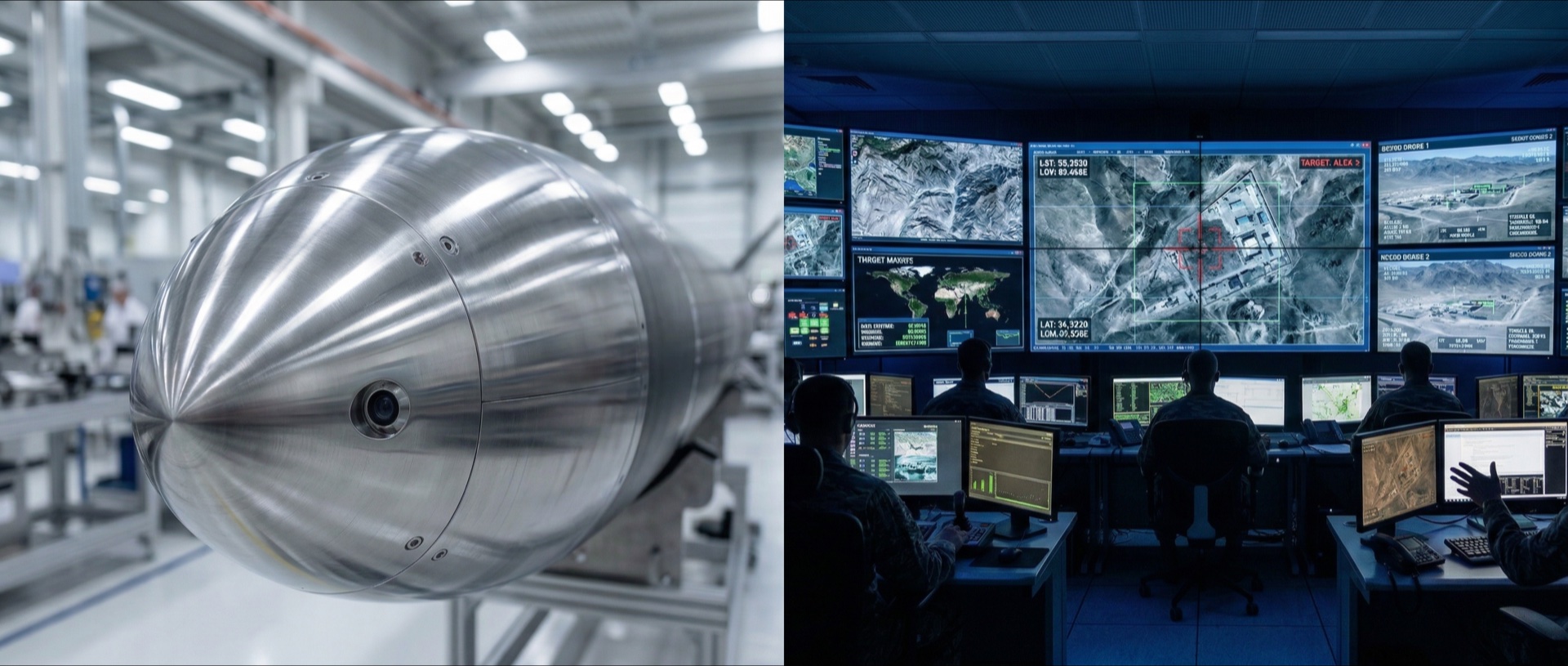
Most of the AI conversation right now is about foundation models. Who has the best benchmarks. Which company raised the most money. Whether agents will replace developers.
Meanwhile, the Pentagon's AI and autonomy budget went from $1.8 billion in FY2025 to $13.4 billion in FY2026. Sevenfold increase in a single year. And almost nobody in tech is paying attention to where that money is going.
I spent the past two days digging into it. What I found surprised me.
What's already deployed
When people think about AI in defense, they picture something experimental. Still in the lab. The reality is different.
The PAC-3 MSE interceptor has had an AI component since the program began. Not a recent upgrade. AI from day one, handling detection, tracking, engagement decisions. Lockheed delivered over 600 of them in 2025, ramping to 650 by 2027. The LRASM anti-ship missile uses machine learning to autonomously plan missions, pick targets, and coordinate attacks through heavy electronic warfare jamming. In February, Lockheed's Skunk Works flew a tactical AI agent aboard the X-62A for autonomous missile evasion maneuvers.
Palantir runs what is arguably the most consequential AI platform in active military use. Their Maven Smart System is the Pentagon's primary targeting platform, with a contract ceiling that hit $1.3 billion last year. CEO Alex Karp has said his company is "responsible for most of the targeting in Ukraine," fusing drone video, satellite imagery, and intercepted communications into an operational picture that compresses what used to take hours into minutes. In August, the Army signed a $10 billion enterprise deal consolidating 75 separate Palantir contracts into one.
And as of this week, we know exactly how central AI has become. The Washington Post reported that Anthropic's Claude is powering Maven's targeting in the current Iran campaign, suggesting hundreds of targets, issuing coordinates, and compressing what used to be weeks of battle planning into real-time operations. Hours before the strikes began, Trump moved to ban Anthropic from government contracts after the company refused to allow its tools for mass surveillance and fully autonomous weapons. The AI is already in the loop. The fight now is over who controls it.
Not experimental. Production systems in active use.
What's coming next
The pipeline is bigger than what's deployed.
Anduril is building a $1 billion hyperscale manufacturing facility in Ohio called Arsenal-1. Five million square feet on 500 acres. Production begins in July. The stated goal: "tens of thousands" of autonomous weapons systems annually. Their Fury drone carried a live AIM-120 air-to-air missile during flight testing in February. The company was valued at $30.5 billion last June and is reportedly raising $4 billion at a $60 billion valuation.
The Collaborative Combat Aircraft program has a $6 billion budget to field 1,000 AI-piloted fighter jets. Four companies are competing: Anduril, Boeing, Northrop Grumman, and General Atomics. General Atomics already flew its prototype in a semi-autonomous formation alongside crewed fighters in February.
Shield AI's X-BAT is an AI-piloted VTOL fighter jet with 2,000+ nautical mile range designed to operate autonomously in contested airspace. Full mission capability by 2028. Their Hivemind autonomy software has been deployed on 15+ platforms since 2019.
The defense spending bill adds another $8 billion for drone procurement and $1.3 billion for counter-drone systems on top of the base budget.
The numbers in context
It helps to put these side by side.
The AI lab contracts that make headlines -- Anthropic, OpenAI, Google DeepMind -- are each around $200 million. Real money by startup standards. Rounding errors in the defense AI budget.
Palantir's Army deal alone is $10 billion. The CCA program is $6 billion. Anduril's factory is a $1 billion internal investment. Palantir's market cap is around $328 billion. Anduril has raised $7 billion total.
The $13.4 billion defense AI spend this year is itself just the beginning. The Replicator initiative, launched to field autonomous drones at scale, has $1 billion allocated. The Defense Innovation Unit's budget hit $2 billion for FY2026. The Pentagon's stated goal is to scale autonomous systems across every branch.
If you work in tech and you're tracking where AI investment is flowing, defense is where the growth curve is steepest. And it's accelerating.
What I think this means
I'm not making a policy argument. Reasonable people disagree about where the lines should be on autonomous weapons, and those are important conversations.
What I am saying is that the defense AI buildout is happening at a pace and scale that most of the tech industry isn't tracking. The companies doing this work aren't startups chasing hype cycles. They're building factories, signing decade-long contracts, and deploying systems already in use on battlefields.
Palantir's Karp made this explicit at the a16z American Dynamism Summit this week. His argument: if Silicon Valley takes away everyone's white-collar jobs while refusing to work with the military, the government will nationalize the technology. Musk backed him publicly. Whether or not you agree with the framing, the message to the industry landed -- defense alignment isn't something these companies see as optional.
The AI models getting the most attention, the ones competing on benchmarks and chatbot rankings, are one piece of a much larger picture. The piece that isn't getting attention involves missiles that pick their own targets, targeting platforms that have compressed human decision-making from hours to minutes, and a manufacturing facility designed to produce autonomous weapons at a scale we haven't seen before.
Whether you're building AI products, investing in AI companies, or trying to understand where this technology is heading, the defense side of this deserves more attention than it's getting. The numbers are too big and the trajectory too steep to ignore.
Sources
- PAC-3 AI capability, Lockheed Martin
- X-62A Tactical AI tests, Army Recognition
- Palantir $10B Army deal, CNBC
- Maven Smart System $1.3B, DefenseScoop
- Palantir targeting in Ukraine, Eurasia Review
- Anduril Arsenal-1, Anduril
- Anduril $60B valuation, US News
- CCA drone race 2026, Breaking Defense
- Shield AI X-BAT, Shield AI
- Karp warns Silicon Valley at a16z Summit, Benzinga
- Anthropic's Claude central to U.S. campaign in Iran, Washington Post
John Engates writes about agentic AI, infrastructure, and sometimes national security at exagentica.ai.